For the upcoming school year, I will be teaching grades 7 through 10 English Language Arts. Each grade level will be embarking on a journey of learning based on an overarching theme. Our greatest goal this year, however, will be to read and write every day. By using daily quick writes, responding to texts and challenging students to read daily, students will build their stamina and volume for both reading and writing, but also increase their vocabulary, specific reading and writing skills, and their confidence in LA. Reading and writing will involve conferencing with the teacher to check in, stay on track but also encourage students to keep moving forward. Students are asked to bring a notebook as part of their school supplies that is dedicated solely to LA, because the notebook stays in the assigned bin in the classroom so that it is always handy.
Parents can use FreshGrade as a window into the classroom, as students will select works in progress to share using photos or video chats. While FreshGrade will be used as a platform to collect portfolios for student works in progress, final scores will be collected in PowerTeacherPro. We will primarily use chrome books to access FreshGrade, Kahoot, Blogger, Google Classroom and other tech tools as a part of our learning. There may be some instances where students will use personal devices, but these times will be restricted to educational purposes at the teacher's discretion.
To access any of the theme documents, course outlines, or forms, a digital copy has been added to Google Classroom. Your students can log in with their school user name and password to access Google Classroom at any time. Please also consider signing up for Remind updates to receive notifications and reminders. The information to join Remind is posted in Google Classroom but was also on the brochure or infographic your students should have brought home along with FreshGrade forms and a text list to be signed.
Email is usually best to reach me, although Remind also has a feature for texting if you have quick questions. Meeting face to face is often best and we can book a time to speak in person through Remind, email or by phone. I look forward to seeing where this year takes all of the students in LA!
Wednesday, 29 August 2018

Wednesday, 25 October 2017
"No Dress Rehearsal, This is Our Life"
Students in grade 7 last year in our school participated in the opportunity to explore the lyrics of The Tragically Hip, read the graphic novel and listened to the music associated with The Secret Path. Our aim was to apply our knowledge of figurative language to the lyrics, but more important, develop an appreciation for the circumstances surrounding the treatment of indigenous people in Canada. For those unfamiliar with the Alberta curriculum, Social Studies 7 encompasses the time period from pre-contact to post-Confederation (to almost World War I). We explore the legacies of colonialism and should develop an understanding of the impact of differing cultures coming into contact with one another. As part of our performance assessment, students were invited to create an artifact that expressed a symbolic element from the film/novel/lyrics that conveyed a message of reconciliation.
The most compelling aspect of the project, other than the realization that Chanie Wenjack represents just one child of many, was that he was the same age as most of our grade 7 students. We researched the distance he traveled and reviewed maps to see how far away from home he actually was. As a parent of a twelve-year-old at the time, as well as a teacher of three classrooms full of seventh graders, it was heartbreaking to imagine any one of our students in Chanie's shoes. And really, I assume, that was one of the motivations behind The Secret Path in the first place.
I admire Gord Downie for a number of reasons: his intellectualism, his songwriting, his environmental activism and his filmmaking. But beyond these skills and traits, it matters that he used his position on stage for more than just saying goodbye in his final concerts, but leveraged a platform to draw attention to an overwhelmingly complicated issue. In the wake of the concert, and graphic novel/film/album, and now following his passing, there has been a spotlight shone on the path of reconciliation. Moving forward, these calls to action cannot be ignored.
It has been interesting to see the spread of resources to promote exploration and understanding of the intergenerational impact of colonialism, and specifically residential schooling, on indigenous people. TeachOntario is one example that inspired my creation of a Secret Path assignment, and there is now a movement to encourage educators to follow Gord Downie's example, appropriately known as Teach Like Gord. In the aftermath of Gord's death and in particular with the broadcasting of Long Time Running, The Secret Path concert and The Strombo Shows 'The Hip at 30' I am both heartened and motivated by these efforts and am excited to see how The Secret Path project will unfold with our cohort of grade nine students this year.
Saturday, 29 October 2016
NaNoWriMo here we go!
For the past few years I've struggled with how to authentically encourage students to write their own stories. Storytelling in general is a "big idea" in the year's plan, as we explore personal and Canadian identity and work on developing our own voice. Most often we work with the idea of threading together and/or untangling the threads of our own stories (genealogy, personal histories, interviews, visual creations) and uncovering how our own threads are part of the wider fabric of Canada (hearkening back to the idea of the cultural mosaic, but instead of tiles, we operate with a tapestry idea). Typically, we've focused on spooky stories with the goal of building suspense and applying the elements of fiction after reviewing aspects of character, plot, point of view and conflict. We also have reflective journals and blogs, where students share their writing and visualizations of their learning through meta cognition.
This year, a colleague suggested and shared resources for the Young Writer's Program's version of National Novel Writing Month (NaNoWriMo). Having participated in NaNoWriMo in the past myself, I was intrigued and had contemplated how to introduce the idea to students. Informal hallway conversations cannot be discounted (serendipity, really), because from a brief (less than four minutes) chat during class change, as well as some timely sharing through Google, the seed was firmly planted in my mind that this was the year to bring NaNoWriMo to fruition.

Thankfully, we had already worked through the bulk of the elements of fiction and we were able to gauge our daily word count to help us set our writing goals. The two most intriguing parts of introducing NaNoWriMo so far, have been:
(1) the complete and utter engagement of students as they typed to determine their word count (concentration + competition). The simultaneous clicking of chrome book keys on nearly 30 devices at once was an interesting aural experience.
(2) the joy in students' eyes as they were invited to choose their own characters, conflicts and genres, coupled with the cross-pollination of ideas between students. In one class, three friends are collaborating on a single plot, but each writer is focusing on his character's perspective. As the students were sharing their character descriptions and brainstorming plot ideas, another student overheard and ultimately decided to join in on the collaboration.

Overall, I am hoping to continue to foster the excitement we felt on Friday when the idea was introduced. I anticipate focusing on aspects of growth mindset that will propel us forward. We are building a writing culture, therefore we are all writers, we are all capable, mistakes will be made but the frustrations we feel are our brains making new connections. Given that we are also trying to foster a reading culture where everyone is invited to read, a la Donalyn Miller, this year is shaping up to be an adventure. Wish us luck on our journey!
This year, a colleague suggested and shared resources for the Young Writer's Program's version of National Novel Writing Month (NaNoWriMo). Having participated in NaNoWriMo in the past myself, I was intrigued and had contemplated how to introduce the idea to students. Informal hallway conversations cannot be discounted (serendipity, really), because from a brief (less than four minutes) chat during class change, as well as some timely sharing through Google, the seed was firmly planted in my mind that this was the year to bring NaNoWriMo to fruition.
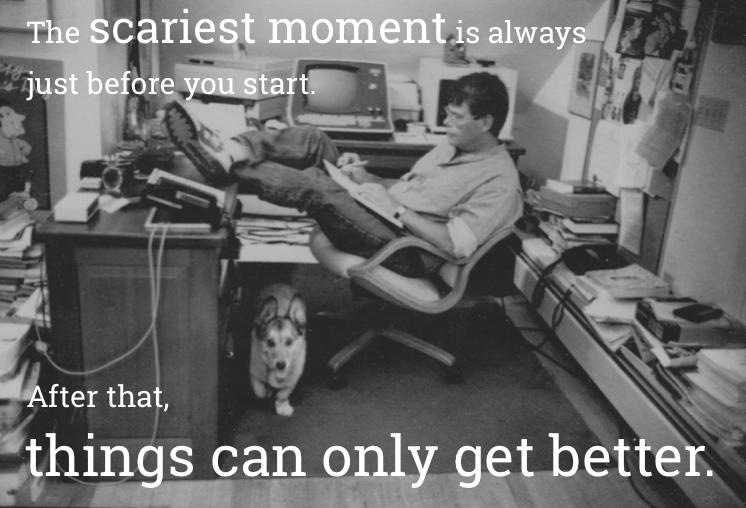
Thankfully, we had already worked through the bulk of the elements of fiction and we were able to gauge our daily word count to help us set our writing goals. The two most intriguing parts of introducing NaNoWriMo so far, have been:
(1) the complete and utter engagement of students as they typed to determine their word count (concentration + competition). The simultaneous clicking of chrome book keys on nearly 30 devices at once was an interesting aural experience.
(2) the joy in students' eyes as they were invited to choose their own characters, conflicts and genres, coupled with the cross-pollination of ideas between students. In one class, three friends are collaborating on a single plot, but each writer is focusing on his character's perspective. As the students were sharing their character descriptions and brainstorming plot ideas, another student overheard and ultimately decided to join in on the collaboration.

Overall, I am hoping to continue to foster the excitement we felt on Friday when the idea was introduced. I anticipate focusing on aspects of growth mindset that will propel us forward. We are building a writing culture, therefore we are all writers, we are all capable, mistakes will be made but the frustrations we feel are our brains making new connections. Given that we are also trying to foster a reading culture where everyone is invited to read, a la Donalyn Miller, this year is shaping up to be an adventure. Wish us luck on our journey!
Saturday, 9 April 2016
Relativity

This week has been challenging on a number of fronts, but our middle school team is strong and we will continue to move forward. As I was reflecting back on a stressful week, I considered the fact that I needed to look at both sides of the coin, instead of focusing on the troubling or stressful aspects. I was reminded of a late night tv show, where moments are itemized in a "top" list and thought maybe I should pick my standout moments of the week. I'm only sharing my highlights from work, so I feel fortunate in retrospect. The items aren't presented in a particular order, as I don't think I could actually rank them.

10. There were some student breakthroughs this week, which should always be on a highlight reel in our minds, especially in the face of challenges. I won't comment on specifics, but suffice to say students feeling heard-earned success is never to be taken lightly. I also feel that I had a role to play in the growth of a student teacher who finished a pre-service teacher practicum this week. I watched her comfortably redirect students and meaningfully offer feedback, when at the start of the practicum, she expressed fear and self-doubt.
9. Our Wellness committee is moving forward with an exciting opportunity to create a cross-grade, cross-curricular, community partnership-type of project. I don't want to jinx anything, but there will be some green thumbs involved.
8. I've had the chance to bounce ideas off of some wise and patient colleagues who help me see things from a different perspective, and it helps me to frame my own thinking about lessons, pedagogy and leadership. I have to talk my thinking out, which can be annoying (mostly to spouses, but I digress), but clarifying my thoughts helps me move forward with renewed purpose.
7. A colleague organized an ice cream party where we each brought toppings to share and we spent some time eating treats while we socialized, however briefly, at lunch. I believe a delicious tradition has been born!
6. One day afterschool, a group of teachers were chatting about the full length Rogue One trailer which had just been released that morning ad we were speculating on the foreshadowing elements and how the film fits into the overall Star Wars cinematic universe (unabashed Star Wars nerds abound in our hallway!). Another teacher overheard our conversation and quickly joined, only to drop an epic theory that caused all of us to collectively gasp. Maybe you had to be there for this one, but I promise you, it was definitely a moment.
5. Students in 7C and 7B organized a baby shower/going away party for my teaching partner whose last day was the 8th, as she heads off on maternity leave. The classes were excited to plan snacks and were inspired to write poems (mostly limericks and free verse) in her honour, with two girls organizing the poems into a book to offer as a gift.
4. Another student suggested the possibility of organizing a class poetry reading at a local coffee shop, which likely will come to fruition. It was a piggybacking idea based on our discussion in community circle of the public nature of poetry, especially spoken word, in light of my recent experience.
3. I team taught with my hallway neighbour and we combined our English classes who performed assigned stanzas of "The Highwayman", complete with props, costumes and sound effects. There were some great moments!
2. Students are moving forward with Genius Hour and are mostly at the point where they are drafting their driving questions (thanks tubric!) and I am in awe of their creativity, thoughtfulness, reflection and empathy.
1. At one point in the week, I was at the beginning of my prep period and was gazing down the middle school hallway. As I looked both directions, I saw students practicing Drama projects, partners collaborating on a writing assignment and others working in teams to create Rube Goldberg machines. In some spots, students were sprawled on the floor while others were testing pulleys. I remember a time in our school when people poked their heads into my classroom and questioned what I was doing, because it seemed strange. Now, teachers feel more comfortable taking risks and facilitating more student -centred learning opportunities.
Overall, the collegiality, humour and forward momentum sustain our positive culture and help create a space for our learning community. Maybe last week wasn't as bad as I thought.
Friday, 8 April 2016
Slam!
This week, which coincides with National Poetry month, I was able to take advantage of the opportunity to see Shane Koyczan live. If you're unfamiliar, Shane Koyczan is a Canadian spoken word artist, most often associated with his performance at the Opening Ceremonies of the 2010 Olympics in Vancouver and his poem "To This Day". We study "We Are More", "To This Day', "Troll" and "Instructions for a Bad Day" in Humanities and every year the students are inspired by the style of slam poetry. Spoken Word is immensely appealing to the students and I think it suits middle school because of the perceived freedom with language, as opposed to the stricter formats of haiku, limerick, tanka, acrostic and cinquain that we also experiment with. Without fail, students are inspired to organize a class poetry reading after hearing and watching examples of spoken word (more on that later). Adding to the attraction to spoken word, more than the style of slam poetry itself, are the themes presented by Shane Koyczan. The pursuit of beauty, measuring up, mattering, bullying, and most important, hope, resonate strongly in an audience struggling to develop and assert their identities.


I choose the poems above because they not only resonate with students, but because of their accessibility and the fact that they mesh so well with our overarching themes of kindness, personal and Canadian identity in grade seven. More often than not, the poems we work through in class, which may look like simply watching the videos and generating dialogue, or delving more deeply with a close reading activity, become gateways to further exploration by a student independently. This year, one student asked for suggestions for more spoken word poems to read on her own during spring break, while others activity explored Koyczan's catalogue. You can't ask much more than that!
One of my favourite moments from the reading, aside from the fact that I shared this powerful evening with our oldest days before his birthday, was the performance of a powerful poem that we don't study in class, but is nonetheless a favourite: "The Crickets Have Arthritis." On Sunday night, there wasn't a dry eye in the small venue (100 seats max!), including the poet himself, who politely asked for a tissue after finishing the final line. We joke in class about using poetry to woo women a la Dead Poets Society, or for writing politically-based limericks (many words rhyme with Trump, don't you know), but we also talk about painting word pictures and evoking emotion. Seeing the intense emotion first hand was an unforgettable experience, and my hope is that the students I teach will not only carry the memory of the beauty of words with them for their lifetimes, but actively seek out or create opportunities to share poetry.
Monday, 28 March 2016
Break

In terms of breaks for students and teachers, such as this week, the benefit is time away to refresh and catch up, which may look different for everyone. Even when there is a non- PD break, know that the majority of teachers continue to engage in education-related activity, whether that is marking, planning or researching. Students benefit from a change in routine and an opportunity to participate in different activities.
I'm particularly excited for the opportunity to be part of an audience of 100 people who will see the spoken word poet Shane Koyczan perform. Several teachers in our school use his poetry in class to touch on the themes of identity and kindness, with "Troll", "To This Day", "We Are More", and "Instructions for a Bad Day" being the most often referenced and analyzed. I encourage you to watch Koyczan's TED Talk, listen to his spoken word albums and watch his moving animated versions of his poems. I feel fortunate in particular to be sharing this moment with our son, who is also a fan of the poet.

Looking at the remaining school year, we don't have any significant breaks, with three and four day weekends interspersed with regular work weeks. By June, students will feel stressed and will struggle with positive interactions with peers due to the amount of time spent together. It will be import at to continue to integrate mindfulness into our routine as well as practice our social skills. I am eager to see what the remaining days of the school year will bring!
Sunday, 6 March 2016
The Journey of a Thousand Steps...
I don't always like to leave our classes with a substitute teacher because I am concerned about the loss of learning time and a bit of selfishness on my part because I love being with my students. Sometimes however, opportunities arise that I can't refuse. Our leadership team as well as the team from MHHS were lucky to participate in three full days of learning around the skill of cognitive coaching. The highlight of the three days was the fact that one of my favourite facilitators, John Clarke, was leading the session.
Aside from the humorous storytelling John shares, his ability to recall people's names after only a short period is an impressive and enviable feat. To summarize our time with John Clarke, once again the power of relationships was reinforced as well as the necessity of attentive listening and mutual respect. Cognitive Coaching relies upon one's ability to attentively listen and then paraphrase a person's statements, as well as offering questions. Neither paraphrasing nor questioning are successful without strong listening skills. In grade seven, we practice attentive listening and differentiate listening from hearing. Looking at ELA's outcome 5 and the Dimensions of Thinking from Social Studies, the so-called 'soft skills' of listening are critical to a student's success not only in schooling, but beyond the classroom.
 Hearing is often accidental, involuntary and requires little, if any, effort. On the other hand, effective listening is purposeful, intentional and requires focused, sustained attention. In grade seven, we utilize numerous Tribes strategies and Kagan structures to facilitate the growth of this necessary skill. I usually start the year with very intentional activities, including creating a look, sounds, feels like chart for listening, along with the remaining agreements. During the year, we revisit the skill, and will be doing so again in the coming weeks. We will also revisit our nonverbal communication, as we in fact transmit far more with our body language than we do with our words and actions.
Finally, the power of reflection was also reinforced during the Cognitive Coaching session. Aside from blogging, students and teachers alike greatly benefit from thinking about our own thinking (meta cognition) as well as thinking back to how we can improve on our learning experiences. When I initially embarked upon my Tribes journey, the story of how Jeanne Gibbs integrated the image of a pelican (named 'reflection") into the Tribes process always sticks in my mind. One piece of writing from Jeanne Gibbs serves as a reminder of the importance of reflection for teachers:
Invite the pelican that soars over the Tribes Trail to be your constant companion. Her name is Reflection. She will tell you, rather immodestly, that she makes the Tribes process work well
anywhere.... Reflection knows that if you watch from the bird's eye view, classroom management
goes more smoothly. Reflection is a wise bird who can describe just what she saw or heard while
people worked together.... reflection clears up confusion and helps everyone soar to greater heights.

We reflect on our learning in class daily, with something as simple as a sticky note listing one idea that sticks with us, or by writing that is more detailed in our journals or blogs for example. We also encourage reflection by providing think time for students to quietly "percolate" on a specific question or idea. I hope that each of my students is fortunate enough to have someone outside of school who also asks them questions about the school day and what stayed with them by evening.
Aside from the humorous storytelling John shares, his ability to recall people's names after only a short period is an impressive and enviable feat. To summarize our time with John Clarke, once again the power of relationships was reinforced as well as the necessity of attentive listening and mutual respect. Cognitive Coaching relies upon one's ability to attentively listen and then paraphrase a person's statements, as well as offering questions. Neither paraphrasing nor questioning are successful without strong listening skills. In grade seven, we practice attentive listening and differentiate listening from hearing. Looking at ELA's outcome 5 and the Dimensions of Thinking from Social Studies, the so-called 'soft skills' of listening are critical to a student's success not only in schooling, but beyond the classroom.
Finally, the power of reflection was also reinforced during the Cognitive Coaching session. Aside from blogging, students and teachers alike greatly benefit from thinking about our own thinking (meta cognition) as well as thinking back to how we can improve on our learning experiences. When I initially embarked upon my Tribes journey, the story of how Jeanne Gibbs integrated the image of a pelican (named 'reflection") into the Tribes process always sticks in my mind. One piece of writing from Jeanne Gibbs serves as a reminder of the importance of reflection for teachers:
Invite the pelican that soars over the Tribes Trail to be your constant companion. Her name is Reflection. She will tell you, rather immodestly, that she makes the Tribes process work well
anywhere.... Reflection knows that if you watch from the bird's eye view, classroom management
goes more smoothly. Reflection is a wise bird who can describe just what she saw or heard while
people worked together.... reflection clears up confusion and helps everyone soar to greater heights.

We reflect on our learning in class daily, with something as simple as a sticky note listing one idea that sticks with us, or by writing that is more detailed in our journals or blogs for example. We also encourage reflection by providing think time for students to quietly "percolate" on a specific question or idea. I hope that each of my students is fortunate enough to have someone outside of school who also asks them questions about the school day and what stayed with them by evening.
Saturday, 20 February 2016
Re-ignition
It's been ages since I've posted, owing to the reliance on Google Classroom for communication. However, after finding inspiration in some of the sessions I attended during Teacher's Convention and from my colleagues, I've recommitted to sharing my writing. I was reminded of my belief that I shouldn't ask anything of my students that I wouldn't carry out myself and in the spirit of setting an example, here we are, writing again.

Spring is just around the corner, and we are well into the second semester. Looking forward to spring, we will be embarking upon Genius Hour and continuing with our "Grow Your Own Society" project, among other smaller lessons and learning experiences. There will be a Genius Hour package to introduce this exciting adventure and I will post a separate entry dedicated to GH. 7B and 7C have had the opportunity to collaborate with 7D and 7E as Mrs. Sawicki and I have been team teaching parts of the Society project. Our goal with this project-based learning experience is to share examples from the rich history of Canada's development as a nation and encourage critical and creative thinking.
For the society project, students have been challenged to develop a society from the ground up, having landed in an unknown land and figuring out how to first meet basic needs, which places them in a similar position to the early European explorers and settlers. As the project develops, students are tasked with understanding and applying the cornerstones of a society beyond basic needs: values and beliefs, rules and decision-making and roles. Using a mini-lesson format, students will learn about and revisit important moments, people and stages in the growth of Canada as a country, starting with early contact and moving towards Confederation. Along the way, students will be faced with decisions and challenges as they move their societies forward. The "Grow Your Own Society" project covers 7.1 of the Social Studies 7 curriculum as well as all five general outcomes from English Language Arts. Beyond the specific Leander outcomes in Social Studies, the project also targets the dimensions of thinking.
I am both a visual and auditory learner, but one of the most compelling ways to summarize the Social Studies curriculum is the visual that accompanies the explanation of the content:
You will see that the "big ideas" in the centre were the focus of our first semester, as we explored our personal and Canadian identities in the context of modern Canada. Citizenship and identity continue to be our overarching ideas as these two big ideas permeate Social Studies from kindergarten to grade twelve. As we move outward from the centre, you will see increasing specificity. As students move forward with their Society projects, you will see that time and again, these ideas will be revisited as they explore and wrestle with these ideas. In grade seven, the specific outcomes focus directly on Canada before and after Confederation. We are taking another look at the fur trade and are comparing the French and British exploration and colonization of the New World, as well as the impacts on the indigenous peoples. There will be adaptation, bloodshed, conflict and competition for resources. If your student hasn't already mentioned the Society project, ask them what their tribe has decided to name their society and what their form of decision-making is as well as their survival plan. I hope you are as intrigued and proud of their thinking as we are!
Sunday, 4 October 2015
Technology Can Be Helpful
Free Technology for Teachers: Have You Tried Voice Typing In Google Docs? - It's Easy to Use
I'm always looking for different ways to encourage all learners to be successful. The link to this tip for using the voice typing tool in Google docs could be very helpful for students who struggle with typing or writing their thoughts. I also recommend ReadWriteGold as a speech to text as well as text to speech extension that students can access in Google as well. It is worth exploring the Google web store for a variety of extensions and apps that students can utilize to become more independent with their learning.
If you have questions about how we are using the chrome books in class, please ask your students about our goal setting conferences this week. Each student will be able to walk his/her parent/guardian(s) through our learning so far, including our use of technology in the classroom. Students will lead these conferences on Wednesday, October 7 from 4:30 -6 and Thursday, October 8 from 6 - 8:30. If these times do not work with your schedule, please contact your home room teacher to book an alternate time.
I'm always looking for different ways to encourage all learners to be successful. The link to this tip for using the voice typing tool in Google docs could be very helpful for students who struggle with typing or writing their thoughts. I also recommend ReadWriteGold as a speech to text as well as text to speech extension that students can access in Google as well. It is worth exploring the Google web store for a variety of extensions and apps that students can utilize to become more independent with their learning.
If you have questions about how we are using the chrome books in class, please ask your students about our goal setting conferences this week. Each student will be able to walk his/her parent/guardian(s) through our learning so far, including our use of technology in the classroom. Students will lead these conferences on Wednesday, October 7 from 4:30 -6 and Thursday, October 8 from 6 - 8:30. If these times do not work with your schedule, please contact your home room teacher to book an alternate time.
Monday, 21 September 2015
Election 2015
From the Canadian Charter of Rights and Freedoms:
Section 3–5: Democratic Rights
Section 3 Democratic Rights
Every citizen of Canada has the right to vote in an election of members of the House of Commons or of a legislative assembly and to be qualified for membership therein.
Sections 3, 4 and 5 of the Charter contain rules that guarantee Canadians a democratic government.
Section 3 guarantees to all citizens the right to be involved in the election of their governments. It gives them the right to vote in federal, provincial or territorial elections, along with the right to run for public office themselves.
Again, some limits on these rights may be reasonable even in a democracy. For example, the right to vote or stand for election is limited to persons 18 years of age or older.
Why Vote?Remember, in not so recent times in Canada, specific groups of people did not enjoy the right to vote (First Nations could not vote until 1960 for example, women fought for the right for suffrage in 1918).
Are you registered to vote in next month's election? If you aren't sure, you can visit the Elections Canada site to check. Please click to visit the online voter registration site!

Saturday, 19 September 2015
Resilience
I meant to post this entry on September 11th, but not for the reason you may think. A few students remarked on the date, but I suspect that since the incidents that occurred in 2001 are before their births, the relevance and understanding of that day does not have the same meaning as it would for others. I remember vividly what I was doing on that day, but now I have a new September 11th memory: the evening I attended the Calgary word Fest event with Amanda Lindhout in 2014:

Having followed the story of her abduction, and seen her speak at a middle school conference and then listened to an audio-book version of her book (voiced by Amanda herself), I have been intrigued, heartbroken and marveled at Amanda's journey. Despite all of the horrific details of her treatment in Somalia and the after effects, Amanda's story is ultimately one of healing and forgiveness. I don't think it was a coincidence that I was able to attend her speaker series on the 11th last year. It was a reminder of the power of forgiveness in the face of remarkable hurt and how a person may choose to overcome the most difficult of personal obstacles.
"I think it's the human spirit inside of all of us that has an enormous capacity to survive."
Community Classroom

For the second year in a row, we are embarking on a rich learning journey. Students will walk to Police Point Park and spend three quarters of their school day outdoors for a week. We will be journaling, exploring First Nations culture with Kokum, and learning about the interactions within ecosystems. All of our learning is tied to the core curricula, as well as Health, Art and Physical Education. We view this learning opportunity as a class and community builder which will be the anchor for our entire year of learning. We are fortunate to be supported by our vice principal, school counselor and principal, as well as Police Point Park, FNMI Education, our school district and most important, parent volunteers. We are hoping that the learning experience will plant a seed in each of the students to see their role in nature, as active citizens and stewards of precious resources. Now, let's just hope the weather cooperates!


Google Classroom
Last year our grade seven students were able to access chrome books in a one to one ratio. Two hundred students were able to open these light, quick devices whenever they needed to. This year the challenge will be to share devices in a one device to two student ratio. So far, we have been managing well to make sure students have technology when they need it with only slight interruptions to our work flow, such as having to pick up chrome books from another classroom. For the French Immersion English class, they have one to one integration in the classroom, as we have a class set of seventeen devices right in our room. Mr. Knight, our very busy and gracious Construction teacher, is busy making a permanent storage station to house our devices. Last year, he furnished the school with beautiful chrome books carts which are still in use this year in several departments. The temporary solution in the classroom is much less organized and aesthetically pleasing:


Google Classroom is one way to integrate technology seamlessly into a classroom. New features are developed frequently which make integration even easier. Assignments cannot be lost, students can catch up on work since it is posted and accessible from any device and the possibilities for collaboration can extend beyond our classroom. If you haven't encountered Google Classroom before, please view the introductory video to get a taste of what it offers. Or better yet, ask your student to give you a personal tour!
Wednesday, 26 August 2015
It is a far, far better thing that I do...
I always think that the opening lines of the Charles Dickens classic A Tale of Two Cities speaks to me more than usual when we are on the cusp of a new school year:
It was the best of times, it was the worst of times, it was the age of wisdom, it was the age of foolishness, it was the epoch of belief, it was the epoch of incredulity, it was the season of Light, it was the season of Darkness, it was the spring of hope, it was the winter of despair, we had everything before us, we had nothing before us, we were all going direct to Heaven, we were all going direct the other way–in short, the period was so far like the present period, that some of its noisiest authorities insisted on its being received, for good or for evil, in the superlative degree of comparison only.
A new school year is the worst of times in that we lose the freedom of summer and the quality time with family and adventure that those precious weeks bring. Many students and teachers are fraught with worry and anxiety, especially if new schools or teaching assignments are on the horizon. Feelings of uncertainty and apprehension are normal but challenging. At the same time, it truly is the best of times as we are set to embark on another year of promise, growth and also adventure. As much as we will all miss the lazy summer days and late nights, as well as the warmth, the crinkle of dry leaves and the spirit of excitement that comes with fall are also welcome.
It was the best of times, it was the worst of times, it was the age of wisdom, it was the age of foolishness, it was the epoch of belief, it was the epoch of incredulity, it was the season of Light, it was the season of Darkness, it was the spring of hope, it was the winter of despair, we had everything before us, we had nothing before us, we were all going direct to Heaven, we were all going direct the other way–in short, the period was so far like the present period, that some of its noisiest authorities insisted on its being received, for good or for evil, in the superlative degree of comparison only.
A new school year is the worst of times in that we lose the freedom of summer and the quality time with family and adventure that those precious weeks bring. Many students and teachers are fraught with worry and anxiety, especially if new schools or teaching assignments are on the horizon. Feelings of uncertainty and apprehension are normal but challenging. At the same time, it truly is the best of times as we are set to embark on another year of promise, growth and also adventure. As much as we will all miss the lazy summer days and late nights, as well as the warmth, the crinkle of dry leaves and the spirit of excitement that comes with fall are also welcome.
Fall is one of my favourite times of year, as the weather tends to be less extreme and also because some great novels tend to be released at this time of year. Summer reads tend to be quick and easy for me, with less depth or challenge. Fall means some heavier tomes in both theme and literal weight, with hopefully a great cup of tea to go with it. I won't debate ebook versus physical book, as I enjoy both for different reasons, but digging into a great book regardless of foramt is inexplicably tied to the autumn season for me. In our school, we require silent sustained reading in our English Language Arts classes and I love the opportunity to introduce students to our learning commons and make suggestions. One of the most useful sites that I recommend is www.whatshouldireadnext.com, which invites users to enter the title of the last great book they enjoyed and provides recommendations for titles within the genre. For social media, it may be worthwhile checking out www.goodreads.com, as it allows you to catalogue and rate your reads. I always caution people to take ratings with a grain of salt however, as reading is such an individual experience. An article on Edutopia published today reminded me of the power of the opportunity to build reading time into classes and how valuable this chance truly can be. Aside from working through the curriculum by way of rich, engaging learning experiences, I hope students leave my classes having developed an appreciation for the power of reading. When you visit my classroom, I hope you browse the reading quotes I've posted.
Monday, 6 July 2015
Not so Blue Monday


Saturday, 4 July 2015
Rainy Day Women
This morning I went for my usual long Saturday run, followed by an amazing cup of coffee and breakfast cookie. The weather was nearly perfect: light breeze, low humidity, sunny but not overwhelmingly hot. We took a new trail on the advice of a stranger we had passed last weekend, and it ended up being one of the best run routes I've been on this year. The only downfall was that despite wearing my new shoes, the first third of the run involved numbness in my feet. But, after re-lacing my shoes I was back on the trail. I could have given up or focused solely on the issue of misplaced shoes. Instead, I problem-solved, because the shoes were interfering with my goal to run.

Why the running preamble? Recently, I've been thinking about mindset, thinking patterns and so forth in relation to perseverance. What is it that sets people with positve outlooks apart from those who don't? In university, during a neuroscience class, we were told that reality, and hence the human experience, is nothing more than the function of a nerve impulse. In these terms, what we experience is nothing more than chemicals crossing a barrier and exciting neurons. Part of me appreciates the simplicity of this idea, and yet another part of me thinks that deconstructing existence to neuronal activity negates the beauty of experience. I suppose it does explain different thinking patterns, as levels of neuro - transmitters would determine reactions to stimuli. And yet, this morning on my run, it felt like more than that. Maybe it was just a "runner's high".
Friday, 3 July 2015
Minding the Masses
I've been reading like a fiend this week, finishing a novel about every other day. I read every night usually, as a way to quiet my mind as part of my routine. For as long as I can remember, I've loved books and the pleasure of reading. I'm not loyal to one particular genre, but can more readily tell you what I prefer not to read than anything. For example, romance is not one of the genres I would choose to read. However, even though I'm not a romance fan, I feel for writer E.L. James this week. She was roasted online during a love twitter chat where people could tweet her questions with a specific hashtag. Unfortunately, the chat turned into a prolonged criticism of her work, devolving into outright insulting her writing. I'm wondering if the relative anonymity of the internet emboldened the people participating, as they lashed out with vitriol. I appreciate not enjoying a writer's work, but I don't think I've ever felt the need to send hate mail or tweets to an author whom I didn't believe was effective. When I consider how I provide feedback for students, I suppose that is why I find the twitter hysteria so surprising. I suppose the fact that the tweeters (twits?) were driving home a point without the intent to actually provide constructive feedback means I can't compare the online chat to what teachers and peers provide in class. It does serve as a lesson in digital citizenship, in terms of how anonymity encourages groupthink. I also am curious about whether the fact that society generally holds celebrities, authors included, to different standards impacts how the famous are treated. It seems to me that celebrity engenders a feeling that being famous invites not only criticism, but that the spotlight inherently comes with a certain price. In any case, if I'm reading a book and not enjoying the writing, characterization or any other part of the experience, I simply put the book down, rather than sending a cruel message to the author. Hopefully there are still more people who think as I do.
Thursday, 2 July 2015
Deux
Summer allows me to enjoy some down time, but it always takes me at least 10 days to unwind and stop checking my calendar and work email. With that said, the perception of teachers enjoying a summer free of any school-related work is unfortunately untrue. I'm already planning for the fall, including redesigning the classroom space. I have several education-related books on my reading list and have signed up for a MOOC (it's tangentially related to English). Pinterest sings its siren song as always, as does Twitter.
I'm moving classrooms again which affords the opportunity to purge materials and rethink the classroom set-up. I'm sad to lose a bank of large windows in my current classroom, as the open feeling creates the illusion of a larger space, allows for greater supervision as I move between my classroom and the adjoining collaboration space, as well as the opportunity to capitalize on the natural light (I had planned an indoor herb and fragrance garden). However, we are gaining double the whiteboard and bulletin board space. As an added bonus, they are replacing SmartBoards in many rooms and installing Epson projectors and brand spanking new tables should be arriving shortly. I'm excited at the prospect of providing space for students to showcase their learning and have been browsing sites and blogs for ideas and the extra whiteboard space will enable us to collaborate in another way. The classroom space adjoins a collaboration space we creatively call the "long room" that we are planning to renovate. We really do need to come up with a better name, but nothing has come up as a replacement yet. I look forward to utilizing this space again this year as an extension of the classroom, but also hopefully using it as an opportunity to collaborate across grades.
Aside from changing spaces, my teaching assignment includes prepping for one new class. Oddly enough, I realized I've never really taught a single subject, having been in positions where integrating curricula was expected and encouraged. I have an ELA course, integrated with two dimensions of Health, which I'm thrilled to take on, in addition to Humanities and Film Studies. I'm always excited to revamp my current courses, as we continue to play with PBL, inquiry and hopefully expeditionary learning. I need to keep reminding myself that we need to go slow to create change, but it is a struggle to see initiatives just hitting our school that I know have been in place elsewhere for some time. However, we have made strides as a school since I've taught here and I know we will continue to move forward in the best interest of our students. We will be experimenting with Genius Hour, so I've signed up for a FREE brief course to make sure I can facilitate its integration among our middle school teachers. I'm curious to see where our students' passions will take us this year and hope that the added sharing space in our classroom will allow students to showcase their thinking.
I'm moving classrooms again which affords the opportunity to purge materials and rethink the classroom set-up. I'm sad to lose a bank of large windows in my current classroom, as the open feeling creates the illusion of a larger space, allows for greater supervision as I move between my classroom and the adjoining collaboration space, as well as the opportunity to capitalize on the natural light (I had planned an indoor herb and fragrance garden). However, we are gaining double the whiteboard and bulletin board space. As an added bonus, they are replacing SmartBoards in many rooms and installing Epson projectors and brand spanking new tables should be arriving shortly. I'm excited at the prospect of providing space for students to showcase their learning and have been browsing sites and blogs for ideas and the extra whiteboard space will enable us to collaborate in another way. The classroom space adjoins a collaboration space we creatively call the "long room" that we are planning to renovate. We really do need to come up with a better name, but nothing has come up as a replacement yet. I look forward to utilizing this space again this year as an extension of the classroom, but also hopefully using it as an opportunity to collaborate across grades.
Aside from changing spaces, my teaching assignment includes prepping for one new class. Oddly enough, I realized I've never really taught a single subject, having been in positions where integrating curricula was expected and encouraged. I have an ELA course, integrated with two dimensions of Health, which I'm thrilled to take on, in addition to Humanities and Film Studies. I'm always excited to revamp my current courses, as we continue to play with PBL, inquiry and hopefully expeditionary learning. I need to keep reminding myself that we need to go slow to create change, but it is a struggle to see initiatives just hitting our school that I know have been in place elsewhere for some time. However, we have made strides as a school since I've taught here and I know we will continue to move forward in the best interest of our students. We will be experimenting with Genius Hour, so I've signed up for a FREE brief course to make sure I can facilitate its integration among our middle school teachers. I'm curious to see where our students' passions will take us this year and hope that the added sharing space in our classroom will allow students to showcase their thinking.
Wednesday, 1 July 2015
The Journey of a Thousand Miles...

I've been toying with the idea of a school-related blog for sometime, after abandoning a personal blog around 2008 (the same year I returned to university full time. Coincidence?)... Summer brings for teachers the opportunity to relax, rejuvenate but to also reflect. I've always subscribed to the idea that reflection is critical to pedagogy and frequently record my thoughts privately in an attempt to improve my practice. Oddly enough, whenever I think of the desire to "be better', my mind always tuns to Dr. Evil in the first Austin Powers movie. {Forgive the interlude, but I do have a point here}. Dr. Evil is seated in a circle with a group of people engaged in family counselling. Dr. Evil is relating the story of his childhood, and the quote that stands out for me is Evil's description of his father as "relentlessly self-improving." The whole monologue is hilarious (luge lessons, meat helmets et al.), but those three words have always stuck with me. I was the student who pushed myself, even when I achieved a 99% in a class, I wasn't satisfied. When I actually earned a 100% on a final exam in university, it wasn't as satisfying as I had expected, and I downplayed the achievement. What those moments taught me was that even when a personal goal is achieved, there can often be the desire to push further, to learn more. I also learned that the end product isn't necessarily the reward in itself, but rather it is the process that promotes motivation. Unfortunately for some, reaching one summit is "good enough" for them. I struggle at times to understand the particular mindset where a person feels that achieving a specific mark, a certain distance in a road race, or even a continuous contract is the pinnacle of success. During the course of pursuing my Bachelor of Education, many people, including me, wrote in their philosophies of teaching that they valued lifelong learning. What I have seen in my professional life is that for whatever reason, some people lose sight of the necessity to hone skills, push boundaries and take risks. It is my hope that as an instructional leader, I can facilitate a culture of risk and promote change in our school. It will be messy, it will be frustrating at times, but it will also be a journey with its own rewards.

Subscribe to:
Posts (Atom)